25 Florence Hotels in Historic Walls
A Byzantine tower that held a women’s prison, a chancellor’s Renaissance palace with the largest private garden in the city, a Franciscan monastery in the Fiesole hills, and the Arno-view house tied to ‘A Room with a View’.
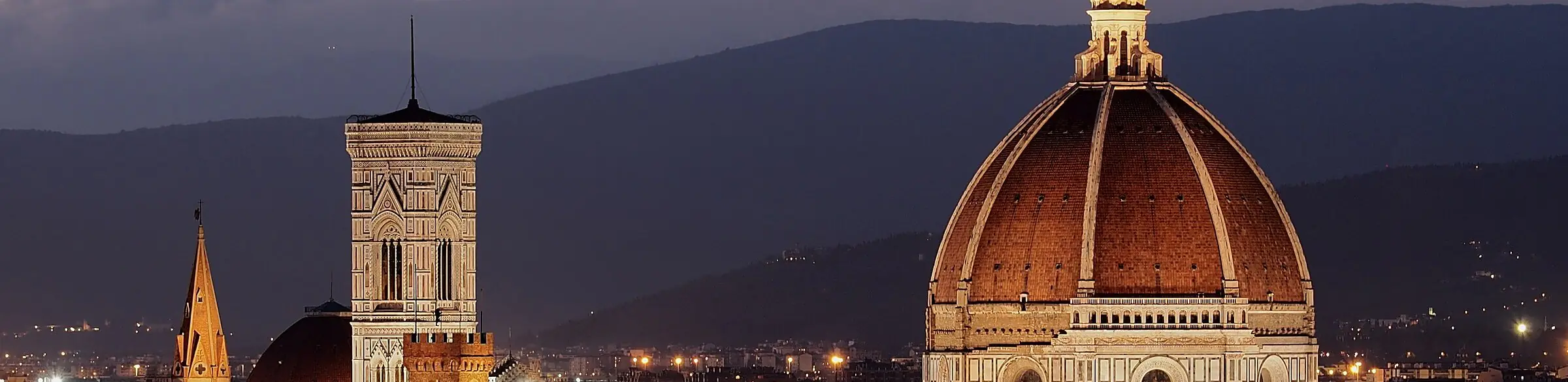
Florence put its palazzi, its medieval towers, and a convent or two to work as hotels. This list has the Byzantine tower by the Duomo that once held a women’s prison, the 15th-century palace of a chancellor of the Republic with the largest private garden in the city, the Franciscan monastery above Fiesole with a facade attributed to Michelangelo, and the hotel on the Arno tied to E.M. Forster’s ‘A Room with a View’.
The list is grouped by character, not ranked. Most of the hotels link to their own site, where the rate is current and you book direct; a few of the chain and small historic houses are listed without a link.
The grand old names
Helvetia & Bristol Firenze · Via dei Pescioni, near Via Tornabuoni
The Helvetia & Bristol has run as a hotel since the 1890s, long a gathering place for writers and artists in the centre of Florence. By the hotel’s account its guests over the years included Pirandello, Stravinsky, Eugenio Montale, and the physicist Enrico Fermi. It reopened in 2019 after a restoration that took in the building next door.
The St. Regis Florence · Piazza Ognissanti, on the Arno
The St. Regis is in a Renaissance palazzo on Piazza Ognissanti, overlooking the Arno, whose original design is traditionally tied to Filippo Brunelleschi. It ran for more than a century as the Grand Hotel before taking the St. Regis name in 2011.
The Westin Excelsior, Florence · Piazza Ognissanti, on the Arno
The Westin Excelsior was formed from historic palazzi on Piazza Ognissanti, one of them said to have been a home of Carlotta Bonaparte, a niece of Napoleon. It has run as the Excelsior, a grand hotel, since the early 20th century.
Hotel Bernini Palace · Piazza San Firenze, near Palazzo Vecchio
The Bernini Palace has been a hotel since the late 1890s, in a building of much older origins near the Palazzo Vecchio. Its frescoed Sala Parlamento is said to have hosted deputies of the Italian Parliament while Florence was the country’s capital, from 1865 to 1871.
NH Collection Firenze Porta Rossa · Via Porta Rossa, near Piazza della Repubblica
The Porta Rossa bills itself as one of the oldest hotels in Italy, with an inn traced on the site to the late 14th century. It is built into a medieval block that takes in the Torre dei Monaldi tower.
Hotel Savoy · Piazza della Repubblica
The Savoy opened in the 1890s, during the rebuilding that cleared the old city centre to make Piazza della Repubblica. It has been a Rocco Forte hotel since 2000.
Grand Hotel Minerva · Piazza Santa Maria Novella
The Minerva is the only hotel on Piazza Santa Maria Novella, in business for about 150 years since the late 1860s. The site earlier lodged visitors to the Dominican convent of Santa Maria Novella next door. Its rooftop pool and terrace look across to the basilica’s facade.
Grand Hotel Baglioni · Piazza Unità Italiana, near Santa Maria Novella
The Baglioni opened in 1903 and has stayed a Florentine-run grand hotel. Its rooftop restaurant and terrace look toward the Duomo.
Towers and old stones
Hotel Brunelleschi · Piazza Santa Elisabetta, near the Duomo
The Brunelleschi is built around the Torre della Pagliazza, a circular Byzantine-era tower counted as the oldest standing structure in Florence. The tower is recorded as a women’s prison in the Middle Ages. A small museum in the hotel shows Roman and Byzantine remains dug up on the site.
Continentale · Vicolo dell’Oro, by the Ponte Vecchio
The Continentale is built around the Torre dei Consorti, a medieval tower beside the Ponte Vecchio. It is part of the Ferragamo family’s Lungarno Collection, its rooms styled on 1950s Italy.
Antica Torre di Via Tornabuoni · Via Tornabuoni, on the Arno
The Antica Torre is set in a medieval tower-house, the Torre dei Gianfigliazzi, at the Arno end of Via Tornabuoni. The poet Alphonse de Lamartine is said to have lodged in the building, which carries a plaque to him.
Torre di Bellosguardo · Bellosguardo hill, above the Oltrarno
Torre di Bellosguardo is built around a 13th- or 14th-century tower on the Bellosguardo hill, with a view over the whole of Florence. The hill and its villa are tied by local tradition to Renaissance owners and later visiting writers.
Renaissance palazzi
Four Seasons Hotel Firenze · Borgo Pinti, near San Marco
The Four Seasons is in the 15th-century Palazzo della Gherardesca, built for Bartolomeo Scala, chancellor of the Florentine Republic. It also takes in a former convent, the Conventino, restored as part of the hotel. The grounds are the Giardino della Gherardesca, the largest private garden in central Florence.
Palazzo Guadagni · Piazza Santo Spirito, Oltrarno
Palazzo Guadagni is an early-16th-century Renaissance palace on Piazza Santo Spirito. Its open rooftop loggia was among the first on a Florentine private palace.
Palazzo Niccolini al Duomo · Via dei Servi, steps from the Duomo
Palazzo Niccolini al Duomo is a 16th-century palace steps from the Duomo, held by the Niccolini family and still furnished with period frescoes and antiques. The hotel places it on the site of houses and workshops once tied to Donatello.
Hotel Monna Lisa · Borgo Pinti
The Monna Lisa is in a medieval palazzo on Borgo Pinti, dating to the 13th or 14th century. The hotel links it to the Gherardini line, the family of Lisa Gherardini, the ‘Mona Lisa’. It keeps a private garden and an original stone staircase.
Palazzo Vecchietti · Via dei Vecchietti, near Via Tornabuoni
Palazzo Vecchietti is a 16th-century palace rebuilt for the Vecchietti family, with work attributed to the sculptor Giambologna, who was their protégé. His bronze ‘Diavolino’ once marked the corner of the building.
Palazzo Magnani Feroni · Borgo San Frediano, Oltrarno
Palazzo Magnani Feroni is a 16th-century Oltrarno palace, once the residence of the Magnani and Feroni families. It keeps its grand salons, a billiard room, and a rooftop terrace over the city.
Villas in the hills and on the Arno
Grand Hotel Villa Cora · Viale Machiavelli, Oltrarno hills
Villa Cora was built in the 1860s and 1870s as a private villa for Baron Oscar Cora, in the hills of the Oltrarno above the Boboli Gardens. The Empress Eugénie, widow of Napoleon III, is recorded among its guests in her later travels.
Villa San Michele, A Belmond Hotel · Fiesole
Villa San Michele was a 15th-century Franciscan monastery in the hills of Fiesole above Florence. Its facade and loggia are traditionally attributed to Michelangelo. It served as a military base and hospital in the Second World War before it became a hotel.
Villa La Massa · Candeli, on the Arno east of Florence
Villa La Massa is a 16th-century Medici-era villa on the Arno at Candeli, just east of Florence. It was a noble country estate before it became a hotel in 1948.
Il Salviatino · Fiesole (Maiano)
Il Salviatino is a 15th-century villa in the hills of Fiesole, tied to the Salviati family. Frescoes recovered during the restoration were kept, and it reopened as a hotel in 2010.
Convents and a room with a view
Hotel Loggiato dei Serviti · Piazza della Santissima Annunziata
The Loggiato dei Serviti is in a 16th-century building made to mirror Brunelleschi’s Ospedale degli Innocenti across the Piazza della Santissima Annunziata, with work attributed to Antonio da Sangallo the Elder. It was built to lodge the Servite friars.
Hotel Morandi alla Crocetta · Via Laura, near Santissima Annunziata
The Morandi is a small hotel in a 16th-century building that was once part of the convent of the Crocetta. Fragments of religious frescoes survive in some of its rooms.
Hotel degli Orafi · Lungarno degli Archibusieri, by the Ponte Vecchio
The Hotel degli Orafi stands on the Arno in the old goldsmiths’ quarter. Its name means ‘of the goldsmiths’. It presents itself as the Arno-view pensione of E.M. Forster’s ‘A Room with a View’.
Frequently Asked Questions
Are these hotels ranked?
No. The groups sort them by character, and the order within each group carries no meaning.
What made a hotel interesting enough for this list?
A story. Every entry was a palazzo, a tower, a convent, a villa, or a grand old name with a documented past. Comfort alone did not qualify a hotel.
Why are there no prices?
Rates change daily and a priced list goes stale in a month. Where a hotel runs its own site, its name links there, so you see the current rate and book direct.
Which hotel puts me closest to the day trips on this site?
Most day trips from Florence leave by train from Santa Maria Novella station, or by road into the Tuscan hills and Chianti. The hotels in the historic centre sit closest to the station.
Do the small hotels book out faster than the grand ones?
Usually. The small palazzo and tower hotels — Palazzo Vecchietti, the Antica Torre di Via Tornabuoni, Morandi alla Crocetta — hold few rooms and fill first. Book those well ahead.