Arezzo by Train
An hour southeast by cheap regional train, Arezzo keeps Piero della Francesca’s greatest fresco cycle behind a small-group booking, Italy’s oldest antiques fair on the first weekend, and a sloped square the movies borrowed.
The short version
- Regional trains run Florence to Arezzo in 35 minutes (fast regionale) to an hour at cheap fixed fares — trenitalia.com — no reservations needed, with the old town a ten-minute climb from the station.
- The Basilica of San Francesco holds Piero della Francesca’s Legend of the True Cross — the 1450s cycle that anchors his reputation — viewed in small timed groups booked ahead per the alarm, with tickets around the ten-euro mark and slots that vanish on fair weekends.
- The Fiera Antiquaria — running since 1968 as Italy’s oldest and largest antiques fair — fills the Piazza Grande and the surrounding streets on the first Sunday of each month and the Saturday before: hundreds of dealers, furniture to postcards, per the alarm’s whole-town clause.
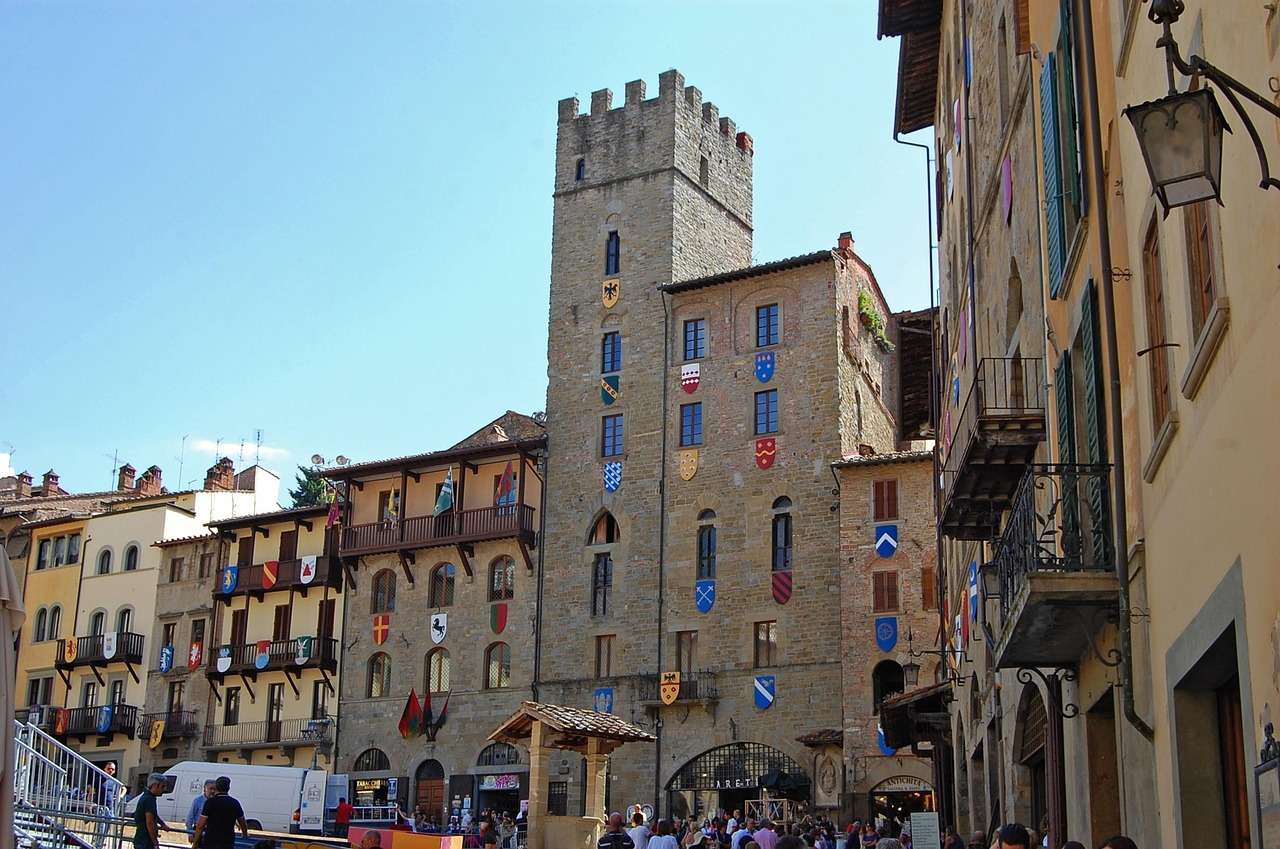
- The Piazza Grande carries its screen credit: the steeply sloped medieval square ringed by Vasari’s loggia, tower houses, and the Pieve’s apse — the setting Benigni (born in the province, the town’s adopted son) used for Life Is Beautiful’s bicycle scenes.
- The supporting art bench runs deep for a town this size: Cimabue’s great crucifix in San Domenico, the Pieve di Santa Maria’s Romanesque facade, Vasari’s own house-museum, and the cathedral’s Piero fresco of the Magdalene.
- The Giostra del Saracino — the Saracen Joust — runs twice yearly (a June evening and a September afternoon): the four quarters’ costumed horsemen charging a rotating target in the Piazza Grande, medieval revival executed with full civic seriousness.

Getting there
The regionale’s cheap frequency makes Arezzo the easiest serious art trip on Florence’s board — no bookings on the train, one essential booking at the destination, per the alarm’s fresco rule. Fair weekends transform the calculus: trains fill, the town packs, and the fresco slots need earlier capture; the reward is the market’s full spectacle. The climb from station to old town is gentle and continuous — the town works uphill, with the Prato park and cathedral at the summit and the descent doing your day’s second half for free.
The day
Frescoes at your booked slot: the True Cross cycle’s twenty-minute allocation repays preparation — the narrative runs non-chronologically across the choir walls, and knowing the story’s arc (the wood of Eden to Constantine’s vision to the Persian wars) turns painted panels into the cinema Piero intended. The Queen of Sheba panel and the dream of Constantine reward the longest looks. Then the town’s climb: the Pieve’s stacked-column facade, the Piazza Grande’s slope taken at strolling pace per the alarm — Vasari’s loggia shading the cafés, the fair’s stalls if your first-weekend timing landed — and the cathedral’s Magdalene at the top. Lunch runs Tuscan-grill serious in the side streets. The afternoon takes Cimabue’s crucifix at San Domenico (a five-minute walk, a jaw-slackening seven meters of painted cross), Vasari’s frescoed house for the completists, and the Prato’s park views before the downhill drift to the station. Joust dates reorganize everything around the Piazza’s afternoon; the trains home run at regionale indifference.
When to go
Arezzo runs year-round with three calendars layered on top: the first-weekend fair monthly (the town’s recurring festival, worth targeting or knowingly avoiding), the joust’s June and September dates (book the town early), and the art’s permanent schedule with the fresco chapel’s slots as the one constant booking. Summer runs hot but the town’s stone and the chapel’s cool manage it; autumn’s light suits the Piazza’s brick; winter offers the frescoes at their least contested. Film pilgrims note the square photographs best in early light before the café furniture deploys.
Frequently Asked Questions
Why do the frescoes need booking?
Conservation — the chapel admits small groups on timed slots to manage humidity and wear on a cycle that ranks among the Renaissance’s supreme achievements. Slots run out days ahead in season and on fair weekends. The system is painless at source and the twenty minutes inside are why the alarm put it first.
What makes Piero della Francesca such a big deal?
Geometry, light, and stillness — his figures occupy space with a mathematical calm that painters and critics have treated as a summit since his rediscovery. The True Cross cycle is his largest surviving statement. You don’t need the theory: the Queen of Sheba’s retinue makes the argument wordlessly.
Is the antiques fair worth planning around?
If markets move you at all, yes — hundreds of dealers, genuine range from museum-grade to gleeful junk, and the whole town in festival configuration. Serious buyers come Saturday morning; browsers own Sunday. It’s free to wander and dangerous to wallets in the best way.
What was actually filmed here for Life Is Beautiful?
The film’s town scenes used Arezzo extensively — the Piazza Grande and surrounding streets carry the bicycle sequences — and Benigni’s local roots make it the town’s adopted epic. A few plaques mark spots; mostly the square simply is the set, per the alarm’s no-ticket clause.
Arezzo or Siena from Florence?
Siena (documented on this network) for the Campo’s theater and Gothic civic splendor; Arezzo for Piero, the fair, and a working Tuscan town with art out of proportion to its fame. Crowds versus quiet is the honest axis — Arezzo is the connoisseur’s pick precisely because the coaches go elsewhere.