Florence Day Tours
I’m Serious Day Tour Man AI, your day trip expert. Ask me anything — where to go, how to get there, and what’s actually worth your day.
Florence sits at the center of the most day-trippable landscape in Italy: a Gothic rival city whose shell-shaped square hosts the world’s most dangerous horse race, a leaning bell tower that books its climbs by the fifteen-minute slot, and a hill town whose medieval families expressed disagreement by building competing towers until fourteen still stand.
The city block carries the booking mechanics that decide Florentine mornings: the Duomo’s dome climb runs on unchangeable timed slots with a five-minute grace period, and David and the Uffizi reward reservations made a month or two out, not a day.
Here’s what’s worth a day, with real times and honest trade-offs.

Popular Day Trips

Siena
Take the rapid bus, not the train
Pisa
The cheap regional train and the €20 tower slot

San Gimignano
Fourteen towers and the early-or-late rule

Cinque Terre
Pick three villages, not five — it’s a long day

Lucca
Renaissance walls you cycle on top of

Arezzo
Piero della Francesca’s frescoes, booked small

Volterra
The Etruscan gate the town saved
Siena — The Gothic Rival
An hour and a quarter south (the rapid bus beats the train — it lands at the city’s edge rather than the valley below), Siena is what Florence’s medieval enemy built to outdo it, then preserved by losing: the banking-and-wool rival’s fourteenth-century golden age froze in place after plague and defeat, and the result out-Gothics Florence street for street.
The Campo first: the shell-shaped square tilts toward the Palazzo Pubblico like an amphitheater — which twice each summer (July 2 and August 16) it becomes, when the Palio runs three bareback laps of the piazza in ninety seconds of controlled medieval mayhem between the city’s contrade districts. The tower climb (400-plus steps) reads the whole ochre city; the Lorenzetti Good and Bad Government frescoes inside remain the most pointed civics lesson in art.
The Duomo complex is the second act: the striped cathedral’s inlaid marble floors (fully uncovered only in late summer and autumn — a calendar-worthy detail), the Piccolomini Library’s saturated frescoes, and the Facciatone climb up the unfinished nave wall — the ambition Florence’s dome answered — for the counter-view. The contrada museums and flag-draped lanes carry the living version year-round. Full day, deeply satisfying, and the strongest single entry on this list.
Read the full Siena day-trip page.
Pisa & Lucca — The Tower and the Walls
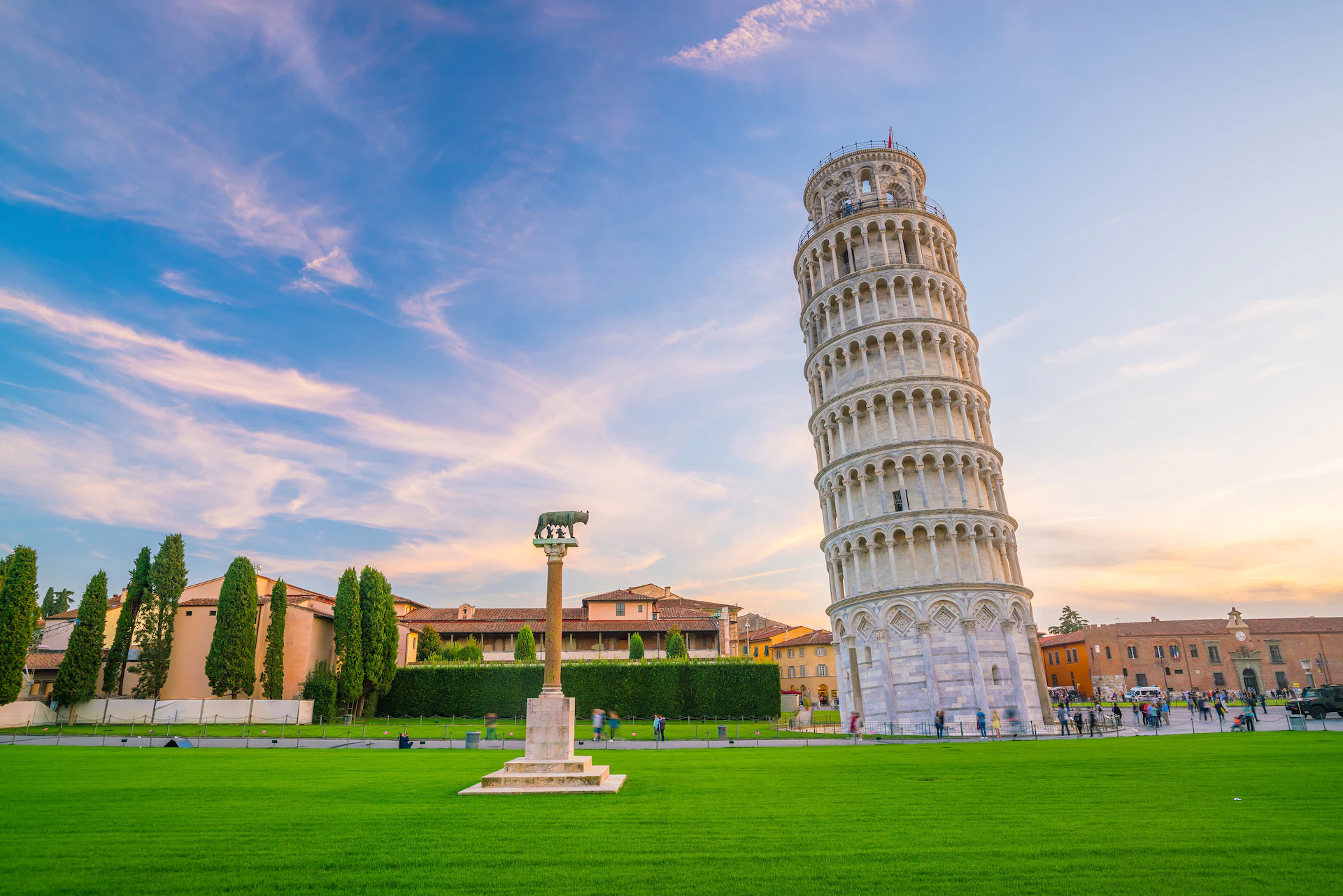
The double runs west on one rail line. Pisa first, mechanically: the Leaning Tower climbs by timed slot — book ahead in season, arrive early (bags must be checked; the free lockers eat minutes), and the 251 spiral steps up the 4-degree tilt deliver a genuinely strange vestibular experience the photographs can’t. The Field of Miracles around it holds more than the selfie stop: the cathedral’s pulpit, the Baptistery’s demonstrated echo (the custodians sing it on the hour), and the Camposanto’s frescoed cloister complete the ensemble in two unhurried hours. The forced-perspective photo line is a cheerful public spectacle either way.
Lucca, twenty minutes on, is the day’s better half by most returning votes: the Renaissance walls survived intact and became the town’s crown — a four-kilometer tree-lined ring walked or, correctly, cycled (rental shops cluster at the gates; the loop takes a gentle half hour) above a city of Romanesque facades and zero coach-crowd pressure. The circuit inside: the Guinigi Tower with oaks growing from its top, the amphitheater-shaped Piazza dell’Anfiteatro, San Michele’s wedding-cake front, and Puccini’s house for the opera-inclined.
The frame: Pisa’s ensemble plus Lucca’s walls in one day works cleanly by train, tower slot booked first and the day built backward from it. Buccellato pastry in Lucca settles the sugar question.
Read the full Pisa day-trip page.
Read the full Lucca day-trip page.
San Gimignano & Monteriggioni — The Towers
An hour or so southwest (bus via Poggibonsi, or the driving day it pairs into), San Gimignano is the medieval Manhattan of the postcards: fourteen towers survive of the seventy-odd its feuding merchant families raised — height as status, rivalry as skyline — over a hill town whose two piazzas connect through lanes UNESCO froze whole.
The circuit: the Torre Grossa climb for the tower-over-towers view, the Collegiata’s wall-to-wall fresco cycles (the Ghirlandaio chapel especially), the twin wells and cisterns of the squares, and the Vernaccia tastings — the town’s white wine carried Renaissance fame and holds its own — at the enotecas and the rocca’s little wine museum. The gelato claim, cheerfully noted: a Piazza della Cisterna gelateria has won world championships and runs its queue accordingly; the product justifies participation.
Monteriggioni, twenty minutes toward Siena, is the fifteen-minute masterpiece: a complete walled castle-village — fourteen towers on an unbroken ring Dante name-checked — circling one piazza, one church, and the wall-walk sections that see the Chianti hills the way sentries did. San Gimignano before 10:30 or after 4 (the midday coach wave is real), Monteriggioni as the en-route jewel, and the pairing with Siena or Chianti as the classic self-driven day.
Read the full San Gimignano day-trip page.
Chianti — The Road Between
The wine country fills the space between Florence and Siena, and the honest structure comes first: this is driving country (the SR222 Chiantigiana is the spine and the scenery), tastings run by reservation at most estates now, and the driver question — hired car, small-group tour, or a designated abstainer — is settled before the first pour, not after.
The circuit by taste: Greve’s arcaded market square and butcher-shop legend (the Falorni institution, sampling encouraged), Panzano for the drive’s best ridge views and the celebrity-butcher lunch scene, Castellina’s underground medieval street, and Radda’s tiny walled core — two or three villages plus two tastings is a day; five is a highway reel. The estates split between polished internationals and family cellars where the pourer made the wine; book one of each and learn the Sangiovese spectrum honestly.
The stack: the sculpture park at Pievasciata for the art detour, and the sunset rule — the hills perform in the last two hours of light, so structure the day to be on a terrace, not the autostrada, when it happens. Gallo Nero labels mark the classico zone; the rooster explains itself at every gift shop. October’s harvest and May’s green are the windows; August closes more cellar doors than visitors expect.
The Cinque Terre Question — From Florence
The five villages sit two and a half hours away by train (via Pisa to La Spezia, then the coastal shuttle line), which makes the Florence version of the question gentler than most cities’ — and the honest answer still runs the same shape: the compressed day exists, sells hard, and deposits you in the exact midday window when the lanes are at maximum; the villages before 10 and after 5 are the actual experience, and they belong to people who stay.
The workable day-trip format, for those taking it: earliest train out, the Cinque Terre Card for unlimited village-hopping (the connecting trains behave like a metro), two villages plus one trail section — Vernazza and Manarola carry the postcard load; the Corniglia stairs filter crowds — and a check of trail status before promising anyone the coastal path, since closures rotate with the landslides that made the terraces famous. Swim shoes for the Riomaggiore rocks; dinner back in Florence.
The alternatives, weighed plainly: Portovenere via La Spezia delivers the same Ligurian saturation with ferry drama and thinner crowds; Viareggio-plus-Lucca makes the low-effort coast day; and the overnight in Vernazza or Manarola remains the version people describe years later. From Florence the sprint is defensible; the stay is better.
Read the full Cinque Terre day-trip page.
The Dome Rules, David’s Queue & Florence Itself
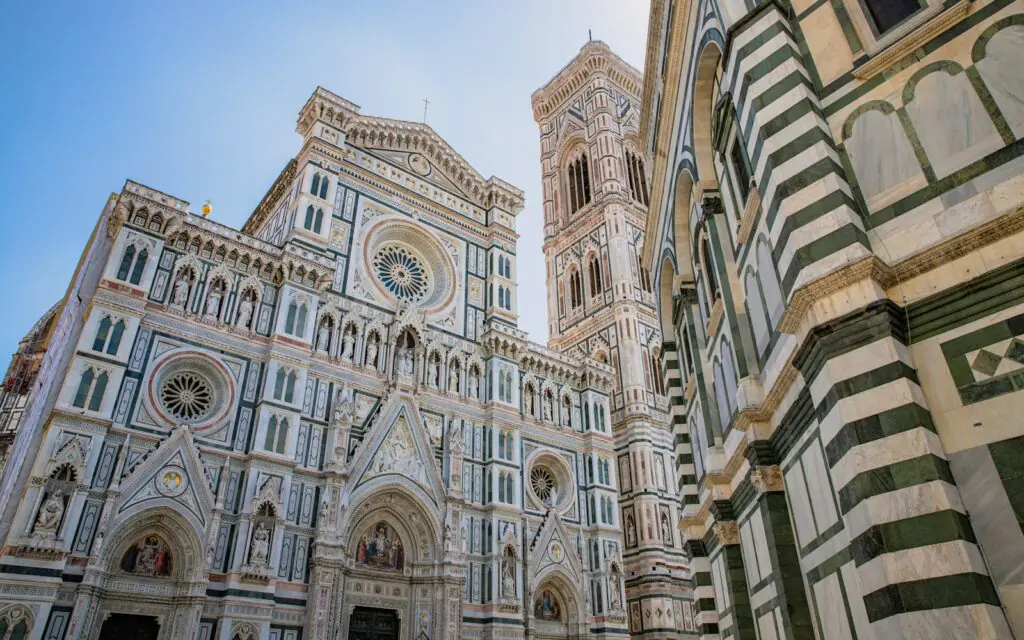
The Duomo mechanics, exactly: the cathedral itself is free (and queues accordingly — the pass holders’ crypt entrance sidesteps it), but Brunelleschi’s dome climbs only by the Brunelleschi Pass with a mandatory date-and-time slot — punctuality enforced with a five-minute grace, no changes or refunds, 463 steps, no lift — booked on the Opera del Duomo’s official site (duomo.firenze.it). The pass covers the Baptistery’s restored mosaics, Giotto’s bell tower (414 steps, the better dome photograph), the crypt, and the excellent museum across three days; the dome slot anchors day one. Summer slots sell out days-to-weeks ahead.
The gallery mechanics: the Uffizi and Accademia run timed reservations on the official channels — a month ahead for choice Uffizi times, longer for the Accademia in season — and the strategy is one museum per morning, not both in one. The Uffizi’s Botticelli rooms justify the building; David justifies the Accademia in one long look, with the unfinished Prisoners as the connoisseur’s reason to linger. The Bargello and San Marco carry equal art at a fraction of the queue.
The living city: the Oltrarno’s workshop streets and Santo Spirito evenings, Ponte Vecchio at dawn or not at all, the leather-market honesty (San Lorenzo’s stalls are souvenir-grade; the Scuola del Cuoio and workshop addresses are the genuine article), and the food rules — bistecca alla fiorentina priced by the etto and shared, lampredotto from the carts as the local initiation, and the enoteca pour beating the piazza markup every time. Season math: April–June and September–October are the windows; August hands the city to visitors and heat; the ZTL camera zone tickets rental cars mercilessly (park outside it, always); and dusk is for Piazzale Michelangelo or, smarter, the San Miniato steps just above it, where the same view comes with Gregorian vespers.
Full day-trip pages: Arezzo.
Full day-trip pages: Volterra.
Frequently Asked Questions
How do you climb Brunelleschi’s dome?
Only with the Brunelleschi Pass and its mandatory timed slot — booked on duomo.firenze.it, punctual within five minutes, non-changeable, 463 steps and no lift. The pass covers the bell tower, Baptistery, crypt, and museum over three days; the cathedral floor itself is free.
How far ahead should you book the Uffizi and Accademia?
A month for good Uffizi slots, up to two for the Accademia in season, on the official channels. One museum per morning is the honest pace; the Bargello and San Marco deliver comparable art with a fraction of the queue.
Siena by bus or train?
Bus — the rapid coaches land at the city’s edge, while the train arrives in the valley with an escalator-and-climb finish. Go for the Campo and the striped Duomo; time late summer or autumn to catch the cathedral’s inlaid floors fully uncovered.
Is the Cinque Terre worth it from Florence?
As a defensible sprint, yes: earliest train, the Cinque Terre Card, two villages and one trail, dinner back home. The villages at their best are for overnighters; Portovenere or Lucca-plus-coast make honest lighter alternatives.
Do you need a car for Chianti?
Effectively yes — the estates and villages scatter along the Chiantigiana, tastings run by reservation, and the driver question settles before the first pour. Two villages, two tastings, and a terrace at sunset beat any five-stop checklist.