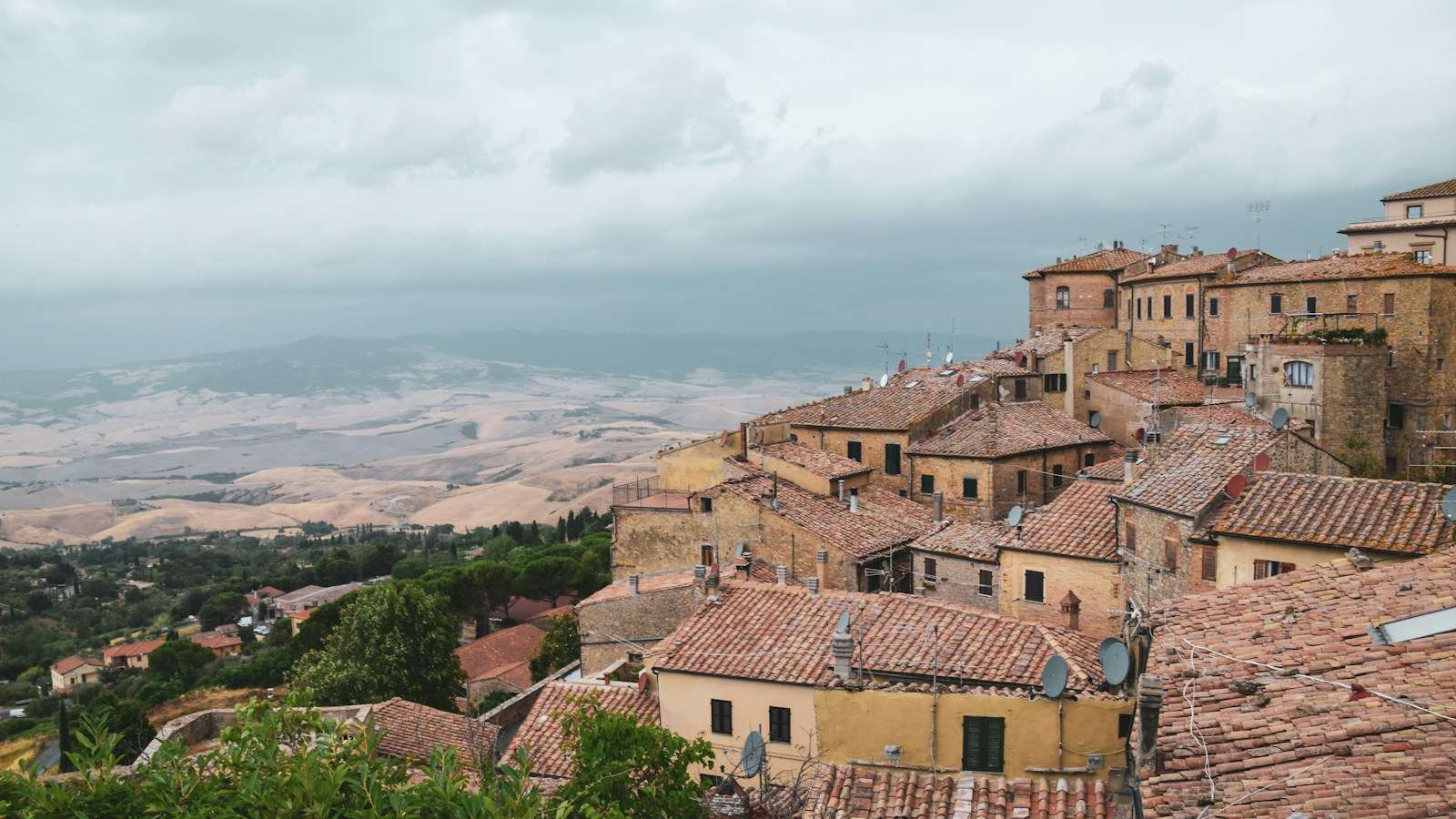
Volterra, City of Alabaster
Ninety minutes southwest and genuinely hard to reach, the Etruscans’ windy hill town keeps its 4th-century-BC gate — saved by townspeople who filled it with stones in 1944 — its alabaster trade, and a fortress that is still a prison.
The short version
- The access truth per the alarm: Volterra sits off the rail map (the bus route via Colle di Val d’Elsa runs thin and slow), and the 90-minute drive or an organized tour is the practical answer — a difficulty that kept the town more Etruscan than themed; town information at volterratur.it.
- The Porta all’Arco is the alarm’s centerpiece story: a city gate of the 4th century BC — three weathered Etruscan heads still watching from its arch — saved in June 1944 when townspeople, warned the retreating Germans would demolish it, filled the opening with paving stones overnight so it held no strategic value; the plaque tells it, and the gate still serves as a door to the town.
- The Museo Guarnacci holds one of Etruria’s great collections: hundreds of alabaster funerary urns and the Ombra della Sera — the Evening Shadow, an elongated bronze votive figure whose modern-looking silhouette (Giacometti two millennia early) became the town’s emblem.
- Alabaster is the living trade per the alarm: Volterra has carved the local stone since the Etruscans, workshops still cut and turn it in open view along the lanes, and buying from a bench you watched beats every airport-tier souvenir — the ecomuseum rooms add the craft’s history.
- The Roman theatre’s best economics are the alarm’s: the 1st-century BC complex, excavated below the walls, views completely from the rampart walk above at zero cost, with the ticketed ground-level entry as the optional close-up.
- The town’s edges carry the rest: the Medici fortress crowning the skyline operates as an active prison (admired from outside per the alarm, with its famed inmate-staffed dinner events as the curious footnote), the balze cliffs west of town show the plateau eating itself, and the Twilight association is told straight — the saga set its vampires here, the film shot in Montepulciano, and the town enjoys the joke at postcard scale.

Getting there
The drive rolls through the Val d’Elsa and climbs the final switchbacks to parking rings below the walls; tours from Florence bundle Volterra with San Gimignano as the standard pairing, which works when the day accepts two compressed halves rather than one whole. The town itself is a compact, sloped oval — everything inside twenty walking minutes — and the ramparts’ circuit is the free spine the day hangs on. Wind is the standing companion: the hill catches it year-round, and the town’s old name for itself leans into it.
The day
Enter through the Porta all’Arco and give the gate its story first — the Etruscan heads, the 1944 plaque, the paving stones’ night retold on the spot where it happened. The Guarnacci takes the museum hour: urn lids’ reclining couples in local alabaster, the Evening Shadow’s impossible slenderness, and the collection’s sheer depth for a town this size. Lunch runs Tuscan-hill standard — wild boar, pici, the local Vernaccia’s inland cousins — before the craft afternoon: an open alabaster workshop watched properly (the dust, the turning, the translucency test against the window), the ecomuseum for the trade’s arc, and the purchase per the alarm’s watched-it-made rule. The rampart walk closes the circuit: the Roman theatre from above at the free angle, the balze’s crumbling drama at the far viewpoint, and the fortress-prison on its height taken as the working institution it is. The Piazza dei Priori — Tuscany’s oldest town hall among its palazzi — pours the closing coffee. The drive home runs the golden-hour hills the tour buses have already left.
When to go
April–June and September–October run the hill at its best — clear light, open workshops, walking temperatures against the standing wind. July–August brings heat the stone lanes store and the tour-pairing crowds at midday; early and late hours restore the town to itself. Winter is the connoisseur’s Volterra: fog rolling the balze, workshops glowing, museums empty — moody, valid, and cold in the way hill towns commit to. Medieval-festival weekends (summer) and the town’s own calendar add costume layers taken or dodged by taste.
Frequently Asked Questions
Is the 1944 gate story true?
Documented and commemorated — the townspeople, facing German demolition plans for the strategic opening, buried the gateway in paving stones overnight so destroying it served no purpose; the gate survived where others didn’t, and the town unbricked its own door after liberation. The plaque at the arch states it; the three Etruscan heads above have watched since the 4th century BC.
What makes the Evening Shadow special?
An Etruscan bronze votive of the 3rd century BC — a boy’s figure stretched to impossible slenderness, its function debated, its silhouette so uncannily modern that the Giacometti comparison writes itself. D’Annunzio’s nickname (the evening shadow that lengthens) stuck. It’s small, it’s the museum’s heart, and the town made it a logo with reason.
Can I watch alabaster being worked for free?
Yes — several workshops carve in open view as the sales floor’s honest theater, and watching costs nothing but the likelihood of buying. The stone’s translucency (lamp-tested at the bench) separates local alabaster from imported soapstone souvenirs; the alarm’s buy-what-you-watched rule is the quality filter.
What’s the actual Twilight connection?
Stephenie Meyer set her vampire aristocracy, the Volturi, in Volterra — and the film adaptation shot its Volterra scenes in Montepulciano, which the town notes with a straight face and a postcard rack. Pilgrims still come; the town enjoys the economy of a legend it neither invented nor hosted, told per the alarm at face value.
Volterra or San Gimignano from Florence?
San Gimignano (documented on this network) for the towers and the easier logistics; Volterra for Etruscan depth, working craft, and fewer coaches — the difficulty per the alarm is the filter. The standard tour pairs them in one day at half depth each; the better week gives each its own.