San Gimignano’s Towers
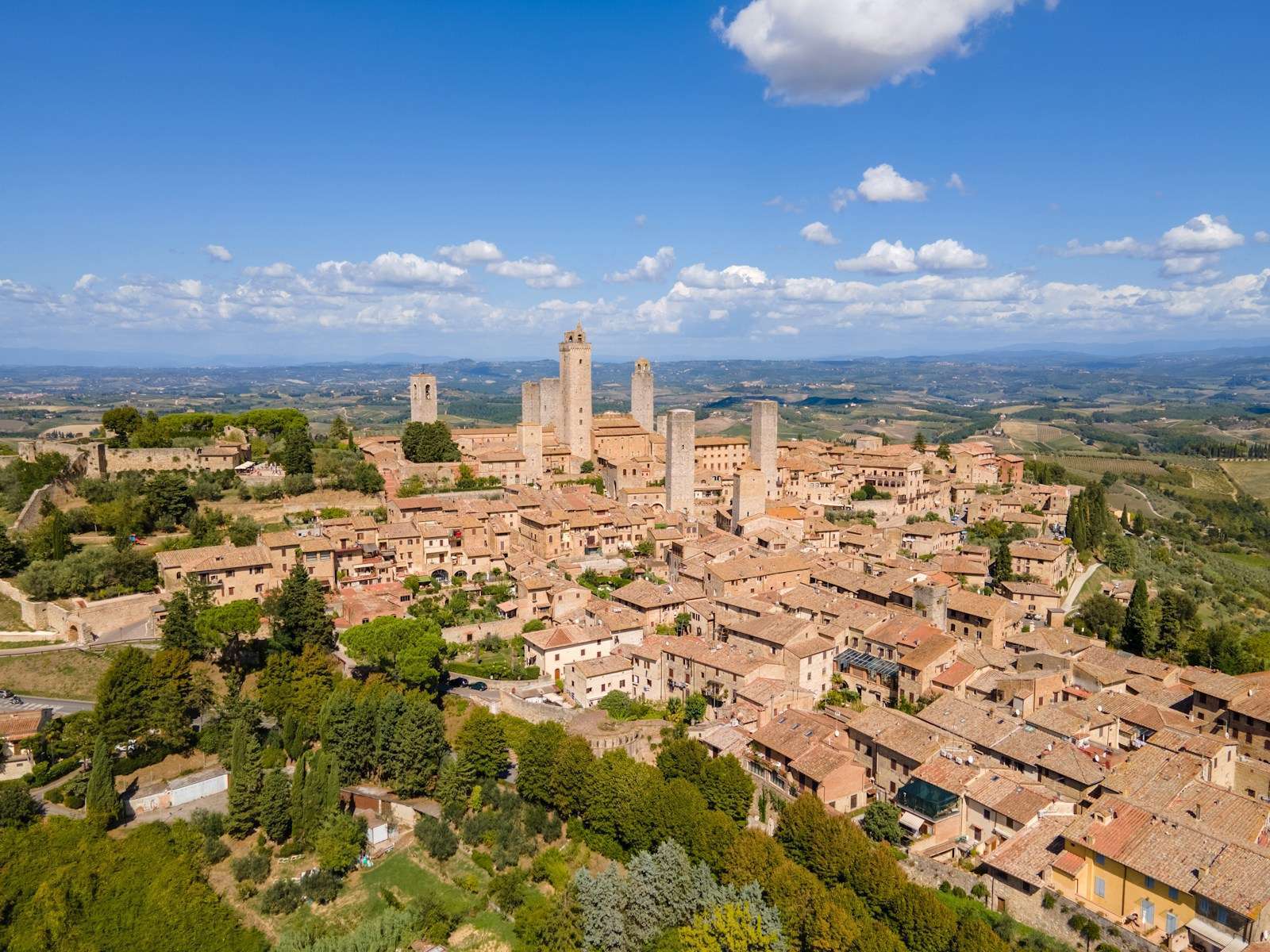
The medieval Manhattan keeps fourteen of its seventy-odd towers on a Tuscan hilltop with no train station. The route is train-plus-bus, and the whole day turns on avoiding the middle of it.
The short version
- The route runs Florence S.M.N. to Poggibonsi by regional train (about an hour), then the 130 bus up to San Gimignano’s gates in 20–25 minutes — train times at trenitalia.com, and the bus timetable’s photo is the alarm’s standing order.
- Of the seventy-some towers the town’s feuding families raised in its medieval boom, fourteen survive — enough to keep the skyline that got the town its Manhattan nickname and its UNESCO listing.
- The Torre Grossa — tallest surviving at 54 meters — climbs from the civic museum for around €9 combined: frescoed halls below, the full Val d’Elsa panorama above.
- The Collegiata’s fresco cycles (Ghirlandaio’s Santa Fina chapel the jewel) and Sant’Agostino’s Gozzoli cycle carry serious art in a town people visit for the skyline.
- Vernaccia di San Gimignano — Italy’s first DOC wine, 1966 — pours at its source in the enotecas and estate rooms; a golden, almondy white that Dante name-checked.
- The gelato institutions on Piazza della Cisterna wear their world-championship banners without shame — the queue is part of the town’s choreography and, per the alarm, moves faster than it looks.

Getting there
The Poggibonsi connection is honest, cheap, and slightly fiddly — which is precisely what keeps San Gimignano’s mornings and evenings human. Regionals leave S.M.N. roughly hourly on the Siena line; the 130 waits outside Poggibonsi station on a coordinated-enough rhythm. The last sensible return bus defines your evening, hence the timetable photograph. Tours from Florence bundle the logistics at tour prices and land, crucially, in the exact midday window the alarm exists to dodge. Drivers park below the walls and climb; the town itself is pedestrian by decree and gradient.
The day
Arrive by ten or after three — the early-or-late rule is the entire strategy. The morning version: the twin piazzas (Cisterna’s well, Duomo’s stage set) before the coaches, Torre Grossa’s climb while the light rakes the valley, the Collegiata’s frescoes, then a long lunch with Vernaccia as the coaches disgorge below — you eat while they queue. The afternoon-arrival version mirrors it: land as they leave, take the golden hours, and hold the evening square nearly alone with the swifts working the towers. Either way, add Sant’Agostino’s quieter Gozzoli cycle, the Rocca’s rampart-and-vineyard views, the scheduled gelato ritual, and an enoteca terrace as the Tuscan sign-off.
When to go
April to June and September to October run the vineyard-green and harvest-gold versions of the same excellent day. July–August compresses everyone into the stone lanes at full heat — the early-or-late rule graduates from advice to survival. Late summer adds the harvest festivals; December dresses the towers for a quiet Christmas-market version. Winter weekdays hand you the town at 1350’s population density, which is the connoisseur’s ticket.
Frequently Asked Questions
Why did the towers exist at all?
Feuding merchant families built them as fortified status — taller meaning richer — until the town capped heights by law. Plague and shifted trade routes froze the skyline in the 1300s; what survived is the freeze-frame.
Is it too touristy?
Midday in season, honestly yes — that’s the alarm’s entire case. At nine in the morning or six in the evening it’s one of the most atmospheric small towns in Italy. You control which version you get.
San Gimignano or Siena from Florence?
Siena (documented on this network) for a full city of art and the Campo; San Gimignano for the skyline and a half-day’s compact perfection. The Poggibonsi line serves both — the ambitious pair them, Siena first.
Is the gelato really that good?
The champion shops are genuinely excellent and know it; the queue is short-order theater. Saffron and Vernaccia flavors play the local card. It’s gelato — join in, enjoy, don’t overthink.
What’s worth buying?
Vernaccia from an estate room (they ship), saffron from the hills that once minted the town’s wealth, and boar salumi from the norcinerias. The ceramics run tourist-grade; Deruta this is not.